

Anaplastic giant cell lymphoma (ALCG) associated with breast implants [APRIL 2025]
July 23, 2025
CO-CHAIR – Dirk Clevert
August 27, 2025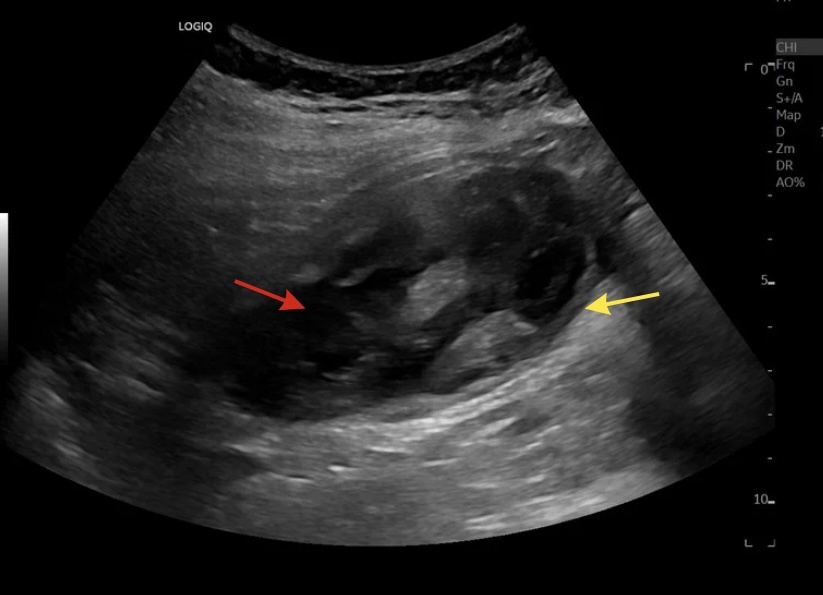
SUBMIT YOUR CASE
EFSUMB invites submission of interesting cases for the website section 'Case of the Month'. All CoM submissions are eligible for selection for free registration at the next Euroson congress. Two cases that receive the most 'likes' in a year will receive free registration for the next EUROSON congress and the third most liked liked case will receive a cash prize of 100 EUR.
An unexpected guest beneath the liver
Authors:
Jovana Tumanov1, Dragan Vasin1, Nikola Grubor2,Jelena Čavić3,Tijana Tomić1
1. Emergency Radiology Department, 2. Institute for Medical Statistics and Informatics, 3. Institute of Pathology, University Clinical Centre of Serbia, 11000 Belgrade, Republic of Serbia,
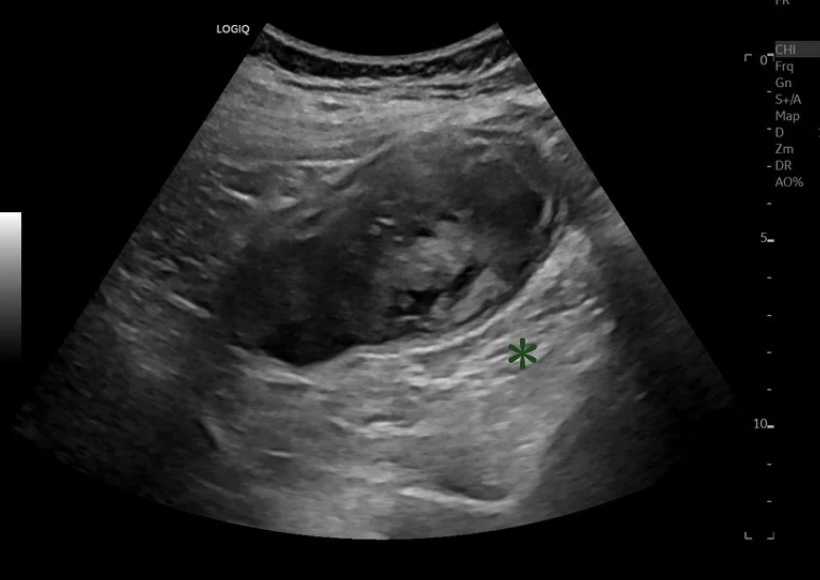
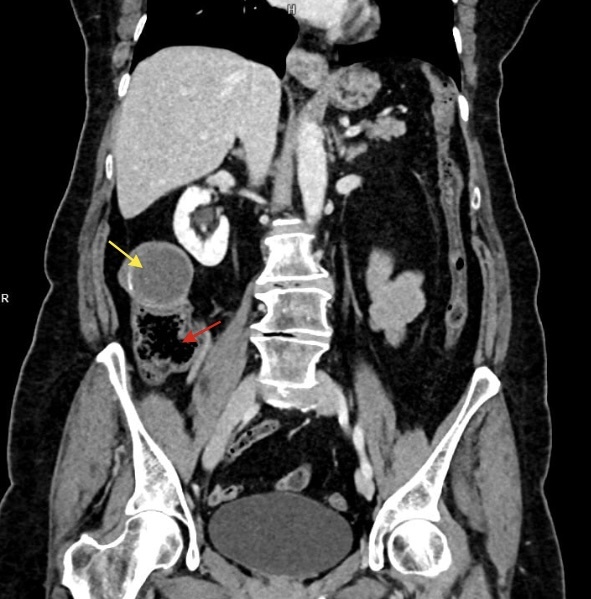
Figure 3. Coronal plane: The yellow arrow indicates the lumen of the lesion measuring up to 100 x 60 x 90 mm (AP x transverse x craniocaudal with the craniocaudal diameter measured in the sagittal plane) contains material of density up to 20HU in the non-contrast phase. The red arrow show the caecum from which the lesion appers to arise. No lymphadenopathy is seen.
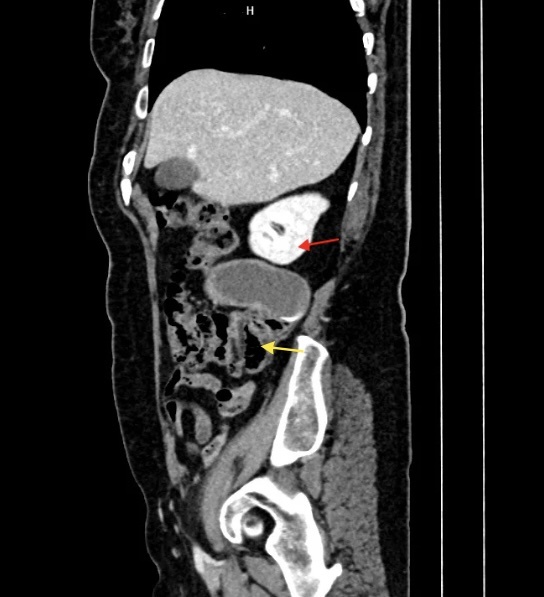
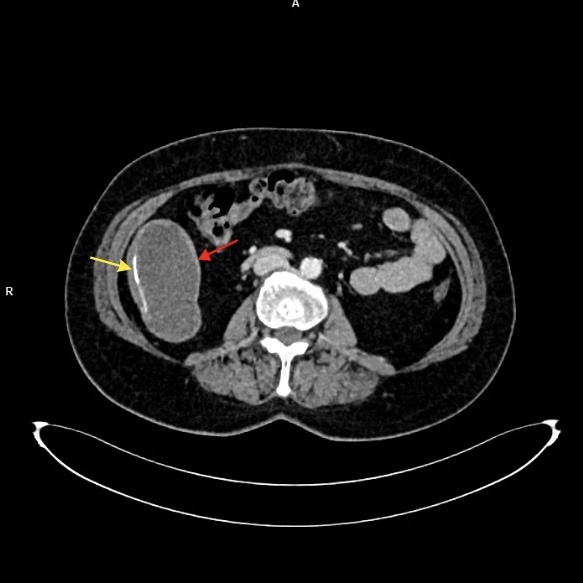
Inflammatory markers are within normal limits, while a mildly elevated tumor marker CEA has been observed.
The patient has a history of total hysterectomy with bilateral adnexectomy performed ten years ago - Histopathologically confirmed diagnosis of microinvasive squamous cell carcinoma of the uterine cervix.
THERAPEUTIC APPROACH:
The definitive treatment for appendiceal mucocele is surgical removal, typically by appendectomy. The surgical approach depends on the size, location, and presence of complications. Simple mucocele without suspicion of malignancy is usually treated with laparoscopic or open appendectomy.
OUTCOME & PROGNOSIS:
Accurate preoperative diagnosis and early surgical treatment of appendiceal mucocele is important to prevent complications like pseudomyxoma peritonei, which has poor prognosis.
2. Differential Diagnosis:Key considerations for a cystic lesion in the right lower quadrant include mesenteric cyst, right adnexal cyst, and retroperitoneal lesions such as lymphangioma or pseudocyst. Precise assessment of lesion location, relation to adjacent structures, and internal features on ultrasound and CT is crucial to distinguish appendiceal mucocele from these entities.
3: Early recognition of appendiceal mucocele is crucial, as rupture may lead to pseudomyxoma peritonei—a potentially life-threatening complication requiring complex surgical management.
2. Bejiga G. Appendiceal mucocele presenting as a leading point in ileocolic intussusceptions: "Case report". Int J Surg Case Rep. 2022; 96: 107307.
3. Mouden MAAE, Laalim SA. A huge appendiceal mucocele. Pan Afr Med J. 2022; 43: 123.